


Before Everything Got Complicated
Two years ago, Jesse quit his job at a mid-size marketing agency to start his own consulting firm. He was good at the work — strategy, positioning, the kind of thinking that makes companies sharper. What he wasn’t good at was keeping track of everything that came with running a business by himself.
The first six months were electric. He landed two retainer clients through referrals, picked up project work on the side, and worked out of coffee shops with his laptop and a notebook. His system was simple: everything lived in a physical notebook and whatever browser tabs happened to be open.
He could see everything. And because he could see everything, everything got done.
It wasn’t organized in any way a project manager would recognize. There was no system. But there didn’t need to be, because his entire business fit within his field of vision.
Then it grew.

When ADHD Object Permanence Starts to Cost You
The third retainer came in August. The fourth in October. By December, Jesse had six active clients, two subcontractors, and a home office with a door he could close. His notebook was full. His tabs were permanent. And things started falling through cracks he didn’t know existed.
That’s when things started to slip.
Not dramatically. Not all at once. Just… quietly. A follow-up email he meant to send on Tuesday that surfaced in his memory on Friday. A deliverable that sat finished on his desktop for three days because he forgot to hit send. An invoice that went out two weeks late — not because he didn’t do the work, but because the invoice lived in a tab he’d scrolled past.
If you’d asked him about any of these things at any point — “Hey Jesse, did you send that email?” — he would have known instantly. No. No I didn’t. It wasn’t that he didn’t know. It was that nothing in his environment triggered the knowing.
But nothing brought it forward.
This is what people call ADHD object permanence — that specific, maddening experience where things you aren’t actively looking at stop pulling on your attention. Most brains have a background process that nudges: “Hey, you were supposed to follow up with the Davis Group.” A quiet tap on the shoulder from your own executive function.
Jesse’s brain doesn’t do that. If it’s not in front of him, it’s not activating anything.
And every tool he’d ever used was designed to hide things.
The Tool Graveyard
After the invoice incident, Jesse decided he needed a system. He’d resisted this — systems felt like corporate overhead, and he’d built a business specifically to avoid that. But six clients and two subcontractors meant he couldn’t keep everything in view anymore.
He started with Asana. Set up projects for each client, created task lists, added due dates. It looked beautiful for about a week. Clean columns, color-coded priorities, a satisfying number of checkboxes.
Then he stopped opening it.
Not because he decided to stop. He just… opened his laptop one morning, went straight to email, then to a client document, then to a call, and Asana never entered his mind. The tasks were still there. The due dates still ticking. But the app was behind a tab, and behind a tab meant invisible.
He tried Notion next. Built a dashboard. Linked databases. Watched YouTube tutorials on how to create the perfect second brain. The build was genuinely enjoyable — his ADHD brain loved the dopamine of creating an intricate system. Using it was another story.
The problem was the same. All of it lived behind a click. Behind a tab. Behind the act of remembering to open it. And once he navigated to a project page, he could only see that project — not the seven other things that also needed attention.
He tried Todoist. Same thing. Trello. Same thing. A physical planner — better, actually, because it sat open on his desk. But it couldn’t hold everything, and it couldn’t update itself, and eventually it got buried under papers.
Each tool worked until it didn’t. Each failure felt personal.
The Meeting He Missed
The Reeves pitch meeting was supposed to be the big one. A $40,000 annual contract. Jesse had spent three days on the deck, researching their competitors, mapping their positioning gaps, building a strategy that would have been genuinely excellent work.
The morning of the pitch, his world was a browser with fourteen tabs, a Slack channel pinging about a different project, an email thread about a subcontractor invoice, and a half-finished proposal for another client. The calendar notification popped up. He dismissed it — “I know, it’s at 2pm” — and went back to the email.
The calendar notification went away. The meeting went with it.
He didn’t realize until he saw the calendar event reappear on his phone with “Started 17 minutes ago” in red text. He drove to the coworking space on autopilot, walked in seventeen minutes late with the pitch deck open on his laptop, and tried to recover.
It didn’t. The client was polite about it. They rescheduled. But when the rescheduled meeting happened, there was a distance in the room that hadn’t been there before. He didn’t get the contract.
Jesse sat in his home office that night staring at the pitch deck — still open, still perfect, still completely useless — and thought seriously about whether he was cut out for running a business.
What Nobody Tells You About ADHD Object Permanence
Here’s what Jesse didn’t know yet, and what most people with ADHD discover only after years of blaming themselves:
The problem was never discipline. It was never motivation. It was never that he didn’t care enough about his clients or his work.
The problem was that every productivity tool on the market is built on the same invisible assumption: that your brain will remind you to look.
Folders assume you’ll remember what’s inside them. Task lists assume you’ll open the app. Databases assume you’ll navigate to the right view. Calendar notifications assume a single ping is enough to hold something in working memory long enough to act on it.
For most brains, it is. The reminder fires, the background process picks it up, the task gets held in working memory long enough to act on it.
For brains like Jesse’s, that background process works differently. It’s not broken — it’s just allocated differently. His brain is exceptional at deep focus, creative problem-solving, and making connections others miss. What it doesn’t do well is hold things in the background that aren’t currently visible.
This is what ADHD object permanence actually describes. Not a developmental gap. Not a memory problem. A mismatch between how the brain manages attention and how every productivity tool expects it to.
Every app Jesse tried solved the wrong problem. They helped him organize information. He didn’t need help organizing. He needed help seeing.
The Wall
The turning point wasn’t an app. It was a wall.
After the Reeves meeting, Jesse cleared everything off the wall behind his desk — the framed prints, the motivational poster his sister gave him — and covered it with index cards and painter’s tape.
He wrote each client’s name on a card. Under each name, he wrote the next thing that needed to happen. He stuck them to the wall, grouped by urgency. Active projects on the left. Waiting-on-response in the middle. Back-burner on the right.
For the first time in months, he sat down at his desk and could see his entire business at once.
It changed everything. Not because the system was sophisticated — it was the opposite of sophisticated. But because it was visible. The Davis Group’s follow-up wasn’t hiding in a task list. It was right there, three inches from his monitor, impossible to not see.
He didn’t have to remember to look. He just had to sit down.
For three months, the wall worked beautifully. His response times improved. His clients noticed. He landed a new retainer. He stopped feeling like a fraud.
Then the wall ran out of space.
When the Wall Isn’t Enough
Twelve clients. Two subcontractors. A growing list of prospects. The index cards started overlapping. The painter’s tape started pulling up paint. He tried a bigger wall. He tried smaller cards. He tried color-coding. But the fundamental problem was physical: a wall has edges.
The wall worked because it made everything visible. But it couldn’t scale because it was physical. And moving a card from “active” to “follow up” meant physically unsticking it, finding space in the new column, and resticking it — during which time he’d get distracted by something else he noticed on the wall.
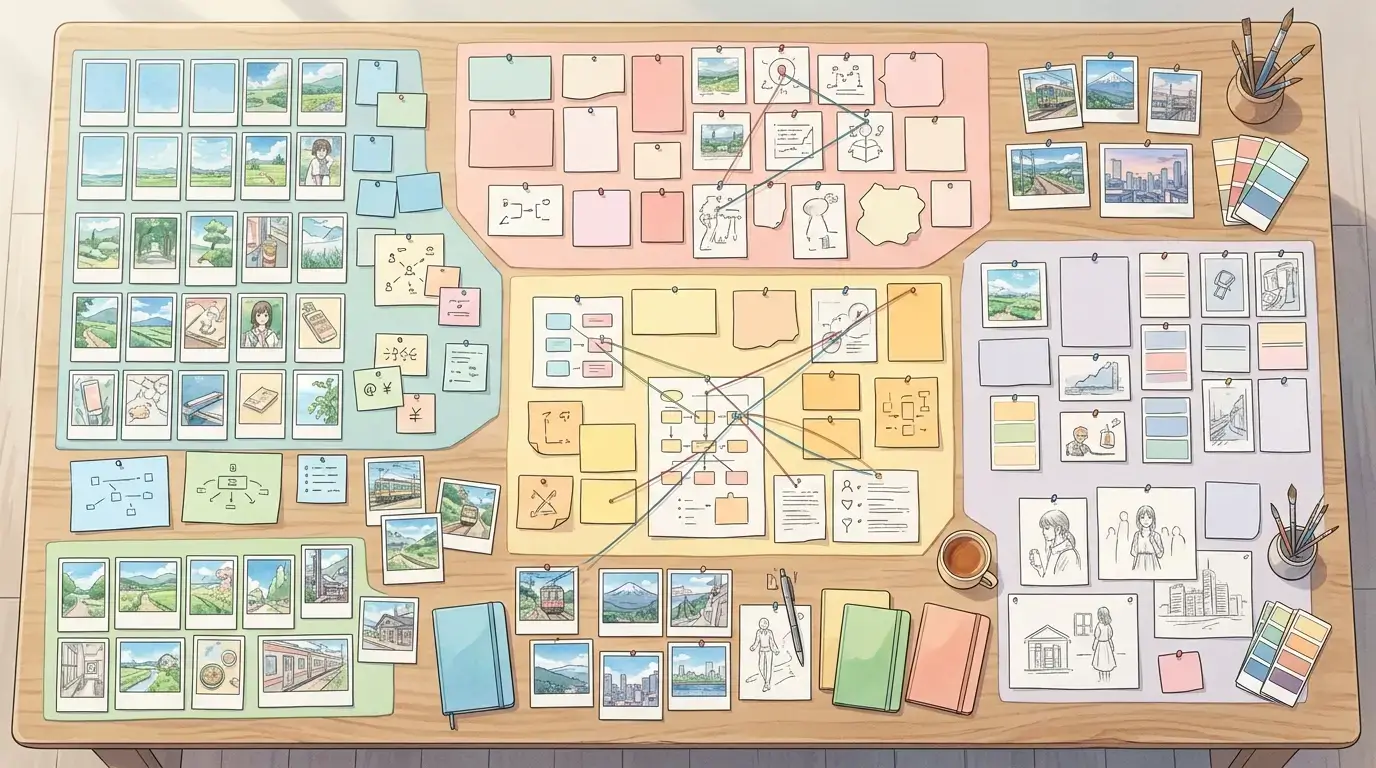
He needed the wall — but digital. Not a to-do list wearing a kanban costume. Not a database with a pretty frontend. An actual workspace where he could see everything, arrange it spatially, and never lose sight of what mattered.
What Actually Works for ADHD Object Permanence
Jesse found it in a visual workspace — a tool that worked like his wall but without the limitations.
No folders. No nested pages. No hidden databases. Just a canvas where everything that mattered existed in one visible space.
His clients weren’t filed in categories. They were placed — spatially, the same way he’d arranged his index cards. Active projects on the left. Waiting on the right. Urgent items pulled close. Back-burner pushed to the edges.

The difference was immediate, and it was the same difference the wall had made, but permanent:
He didn’t have to remember to look. Everything was already in front of him.
That overdue deliverable wasn’t trapped in a task list he needed to remember to open. It was sitting on his canvas, visually flagged, impossible to miss.
For the first time, his digital tools worked the way his brain actually worked. Not by organizing information into structures he’d forget to visit, but by keeping everything visible, spatial, and persistent.
The pitch decks stopped sitting unsent. The invoices went out on time. The clients stopped getting that slight distance in their voice.
Jesse still has ADHD. His brain still doesn’t ping him about things outside his field of attention. The difference is that now, nothing important is ever outside his field of attention.
He didn’t need a better system. He needed a better wall.
If this sounds familiar, you’re not alone — and you’re not broken. Your brain just needs tools that work with it, not against it.